A possible model of cold fusion
Marzo 12th, 2022 | by Marcello Colozzo |
We report the fusion reactions bearing the "helium 4 signature" resulting in the release of energy:
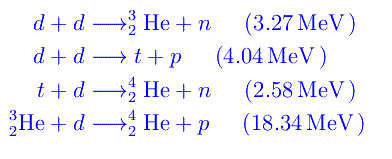
where: p=proton, n=neutron, d=(np)=deuteron (deuterium nucleus), t=(nnp) (tritium nucleus).
That said, a sample of Palladium of volume V is "charged" (through an electrochemical process) with deuterium. For our purposes, we refer to N pairs of deuterons. We schematize this system of N pairs, through an ideal gas, i.e. whose constituents do not interact. Following the standard approach for the study of these problems, we write the Hamiltonian operator of a single constituent (that is, of a single pair of deuterons). Since the single deuteron has electric charge e (where e>0 is the absolute value of the electron charge), the elements of a single pair interact through a repulsive Coulomb potential. Precisely, with obvious meaning of the terms
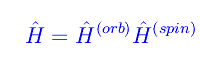
with
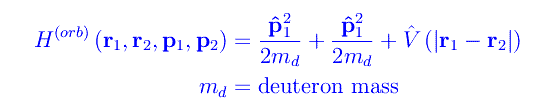
Turning to the relative coordinate system and the center of mass, and neglecting the motion of the latter:

We have
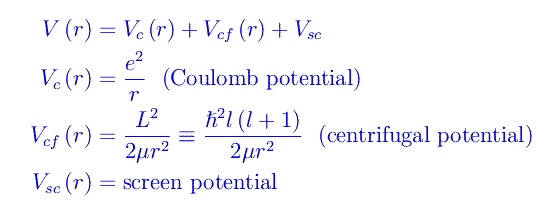
We consider the quantum state with orbital angular momentum with eigenvalue l=0, whereby the centrifugal potential vanishes. The action of the shield potential of the remaining electric charges present in the metal is such that

This determines a "lowering" of the Coulomb potential barrier and a consequent expansion of the classically accessible region. Infact (ε is the energy of a single pair):
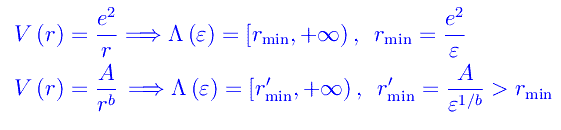
Quantistically, we find that the spectrum of the Hamiltonian is purely continuous:
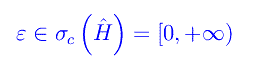
The self-functions of energy
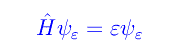
It follows

We are considering a state with l=0

With probability of finding the particle beyond the potential barrier (fusion probability)

What is the minimum energy of a single pair? We observe that

That is, the individual elements of each pair are separated by an infinite distance. Quantistically, it means that the fundamental level of a single pair cannot be zero. So let's calculate the energy of the fundamental level of a single pair. For this purpose we observe that the metal has a finite dimension L=V^{1/3}, for which

It follows that the minimum energy is
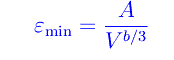
And this is the ground state energy of a single pair of deuterons. From the angular momentum composition rules, it follows that the total spin of a single pair is s=0,1,2. It follows that for any of these values, the system of N pairs is an ideal Bose gas, which, as is known, is characterized by a critical temperature
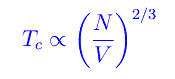
Assuming you have loaded the metal with a density of the number of deuterons such that
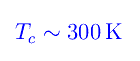
Bose-Einstein condensation occurs at room temperature. Then the individual pairs of deuterons go into the ground state of energy
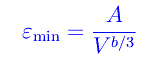
It follows

In other words, if the volume of the metal is sufficiently small, the value of the energy of the ground state is very high, at the infinite limit (for V-> 0), and this could significantly increase the probability of the tunneling process that determines the fusion.


 Congettura di Riemann
 Trasformata discreta di Fourier
 Trasformata di Fourier nel senso delle distribuzioni
 Trasformata di Fourier
  Infinitesimi ed infiniti
 Limiti notevoli
 Punti di discontinuità
 Misura di Peano Jordan
 Eserciziario sugli integrali
 Differenziabilità
  Differenziabilità (2)
 Esercizi sui limiti
 Appunti sulle derivate
 Studio della funzione
 Esercizi sugli integrali indefiniti
 Algebra lineare
 Analisi Matematica 2
 Analisi funzionale
 Entanglement quantistico
 Spazio complesso
 Biliardo di Novikov
 Intro alla Meccanica quantistica
 Entanglement Quantistico